
If your skin suddenly feels tight, dry, itchy, red, or unusually sensitive, your skin barrier may be compromised. Mild irritation often improves when you simplify your skincare routine, avoid potential triggers, moisturize consistently, and give your skin time to settle.
Your skin barrier is the outermost protective layer of your skin. It helps retain moisture while limiting exposure to environmental irritants. When this barrier is disrupted, products you previously tolerated may suddenly sting or burn.
Common triggers include over-exfoliation, harsh cleansers, frequent hot showers, strong active ingredients, and combining too many treatments in one routine.
This skin barrier repair guide explains common signs of barrier damage, practical steps to reduce irritation, ingredients to look for in a moisturizer, and how to reintroduce active ingredients gradually.
Important: This article provides general skincare information, not a medical diagnosis or treatment plan. Persistent, severe, painful, infected, or rapidly worsening symptoms should be evaluated by a qualified healthcare professional.
What Is the Skin Barrier?
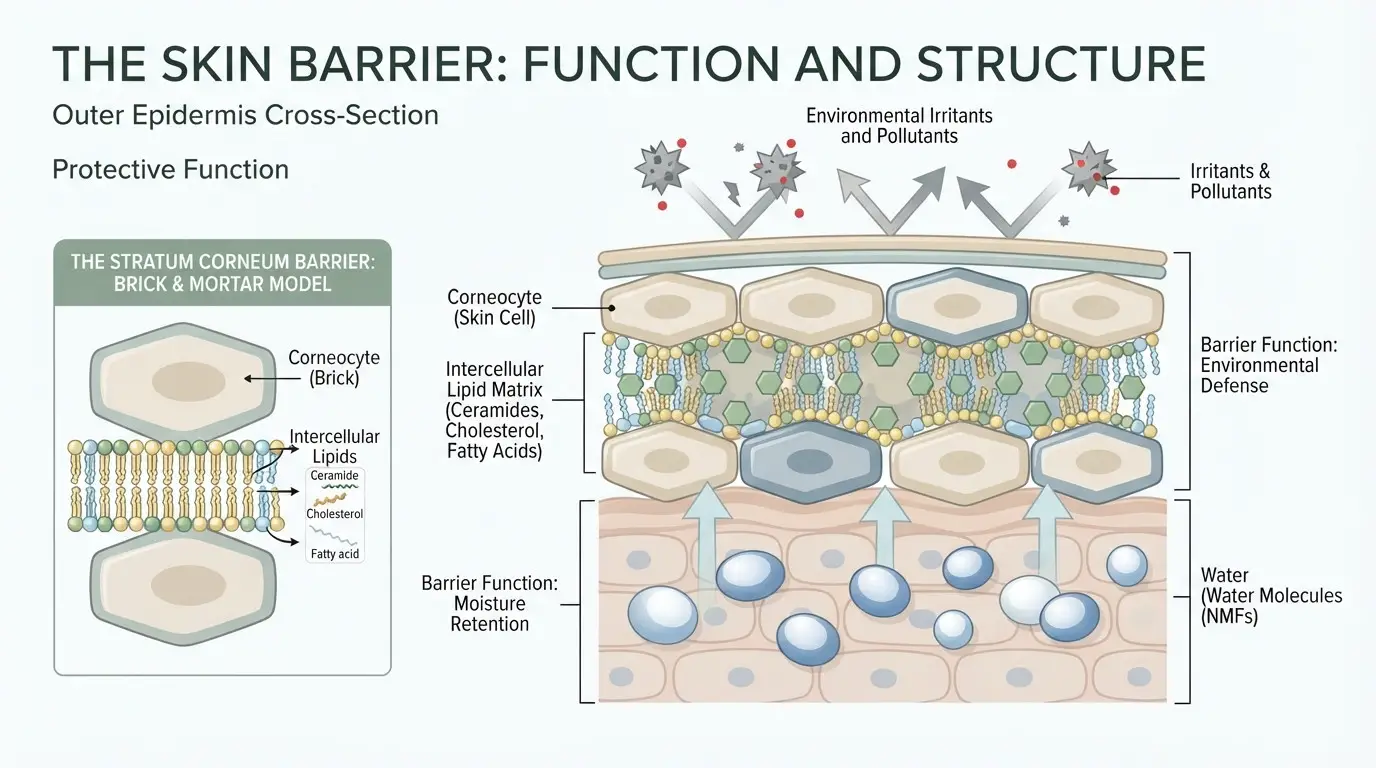
The skin barrier is primarily associated with the stratum corneum, the outermost layer of the epidermis. It is often described using a bricks-and-mortar analogy: skin cells act as the bricks, while lipids such as ceramides, cholesterol, and fatty acids help form the mortar between them.
Together, these structures help limit water loss and protect the skin from external irritants.
A healthy skin barrier does not mean perfectly smooth or poreless skin. It means the skin can retain moisture and perform its protective function without excessive dryness, discomfort, or sensitivity.
When the barrier is disrupted, transepidermal water loss (TEWL) may increase. Water escapes more easily, contributing to dryness, tightness, and flaking.
According to the American Academy of Dermatology Association, gentle cleansing and regular moisturizing are important parts of caring for dry skin.
Why Does the Skin Barrier Matter?
| Function | Why it matters |
|---|---|
| Reduces water loss | Helps maintain skin hydration |
| Provides physical protection | Forms part of the body’s external defense |
| Limits exposure to irritants | Helps protect the skin from environmental stressors |
| Supports skin comfort | Helps maintain a softer, less dry skin surface |
When the barrier is compromised, adding more skincare products is not always the answer. A more useful approach combines gentle cleansing, moisturization, and protection from further irritation.
How to Tell If Your Skin Barrier Is Damaged

Common signs of a compromised skin barrier include:
-
Persistent dryness or roughness.
-
Tightness after cleansing.
-
Flaking or peeling.
-
Redness or uneven texture.
-
Stinging when applying products you previously tolerated.
-
Burning or general discomfort.
-
Skin that feels dry again soon after moisturizing.
One symptom alone does not confirm barrier damage. Eczema, contact dermatitis, rosacea, allergies, infections, and other conditions can cause similar problems.
Timing can provide useful clues. If your skin became uncomfortable shortly after introducing a strong exfoliant, retinoid, peel, or a more intensive skincare routine, irritation from those changes may be contributing.
If symptoms are severe, persistent, or worsening, seek professional advice rather than assuming the problem is simply a damaged barrier.
How to Fix a Damaged Skin Barrier: 7 Practical Steps
If your skin feels irritated, the goal is to reduce potential triggers and create a routine your skin can tolerate. These steps offer a practical approach to reducing irritation and supporting the skin’s protective function.
1. Pause Products That Cause Irritation
Temporarily stop products that consistently cause burning, stinging, excessive dryness, or peeling. Depending on your routine, potential triggers may include:
-
Exfoliating acids such as AHAs and BHAs.
-
Physical scrubs.
-
At-home chemical peels.
-
Retinoids that are causing irritation.
-
Strong acne treatments.
-
Fragranced products or essential oils that your skin does not tolerate.
Not every active ingredient needs to be avoided permanently. The purpose of simplifying your routine is to reduce irritation while your skin settles.
2. Cleanse Gently
Choose a cleanser that removes dirt, sunscreen, and makeup without leaving your skin feeling stripped.
Use lukewarm rather than hot water, avoid abrasive washcloths, and do not scrub flaky areas. If your skin is very dry, avoid unnecessary cleansing throughout the day.
3. Apply a Moisturizer Consistently
Moisturizing helps reduce dryness and supports the skin’s protective function. Applying moisturizer while your skin is slightly damp may help retain moisture, provided this feels comfortable.
Look for a formulation that combines ingredients with complementary roles:
| Ingredient | Main Role | Potential Benefit |
|---|---|---|
| Glycerin | Humectant | Attracts and helps retain water |
| Hyaluronic acid | Humectant | Helps hydrate the skin |
| Ceramides | Skin-identical lipids | Support the skin’s lipid barrier |
| Panthenol | Conditioning ingredient | Helps improve skin comfort |
| Squalane | Emollient | Softens the skin |
| Petrolatum | Occlusive | Helps reduce water loss |
| Dimethicone | Protective emollient/occlusive | Helps reduce moisture loss |
| Fatty acids and cholesterol | Skin lipids | Contribute to barrier-focused formulations |
No single ingredient guarantees recovery. The complete formulation and your individual tolerance matter.
4. Protect Your Skin From the Sun
Use a broad-spectrum sunscreen that your skin tolerates. If your current sunscreen stings, consider a different formulation rather than abandoning sun protection.
Hats, clothing, and shade can provide additional protection. If you use products that increase sun sensitivity, follow their directions and appropriate sun-protection guidance.
5. Avoid Excessive Heat and Friction
Hot showers, rough towels, aggressive cleansing, and repeated rubbing can worsen dryness or discomfort.
Keep showers comfortably warm, pat your skin dry, and moisturize after washing. In dry indoor environments, a humidifier may also help improve comfort.
6. Keep Your Routine Simple
During a barrier reset, you usually do not need several serums, multiple facial oils, or elaborate DIY treatments. Focus on a gentle cleanser, a moisturizer, and sunscreen during the day.
Avoid introducing multiple new products at the same time. Otherwise, it becomes harder to identify what helps and what causes irritation.
7. Reintroduce Active Ingredients Gradually
Wait until your skin is comfortable with your basic routine and significant burning, peeling, tightness, and unusual sensitivity have settled.
Then reintroduce one active ingredient at a time, following product directions and starting less frequently if appropriate. Do not restart several exfoliants or treatments together.
If irritation returns, stop the product and reassess. There is no universal recovery timetable, and persistent symptoms may require professional evaluation.
Best Cream for Over-Exfoliated Skin
There is no single best cream for over-exfoliated skin for everyone. The right moisturizer depends on the severity of irritation, your skin type, allergies, and the ingredients you tolerate.
When skin becomes dry and sensitive after excessive exfoliation, a simple, fragrance-free moisturizer may be more appropriate than another active treatment.
What Ingredients Should You Look For?
-
Ceramides: Help support the skin’s lipid barrier.
-
Glycerin: Helps attract and retain moisture.
-
Panthenol: Can help improve skin comfort.
-
Squalane: Softens the skin.
-
Petrolatum: Reduces water loss and can be useful on very dry areas.
-
Dimethicone: Provides a protective, moisture-retaining effect.
You do not need every ingredient in one product. A well-formulated moisturizer that feels comfortable on your skin is often a sensible starting point.
Avoid choosing a cream based only on claims such as “instant repair” or “barrier rescue.” A product marketed for barrier care may still contain ingredients that do not suit your skin.
If a moisturizer causes persistent burning, swelling, or worsening irritation, discontinue it. Severe or persistent symptoms deserve professional assessment.
For a closer comparison of two popular skincare products, read our Cicaplast vs. Cicalfate review.
Natural Oils for Skin Healing: What You Need to Know
Natural oils can be useful in a skincare routine, particularly as emollients that help soften the skin and reduce the feeling of dryness.
However, the phrase “natural oils for skin healing” can be misleading. Natural does not automatically mean gentle, safe, or suitable for damaged skin.
Some essential oils can irritate sensitive skin, particularly when used undiluted. Fragrance components can also trigger irritation or allergic contact dermatitis in susceptible individuals.
For compromised skin, simplicity is usually more important than the number of natural ingredients.
Potentially useful cosmetic oils and emollients include:
| Oil or Ingredient | General Cosmetic Role | Consideration |
|---|---|---|
| Squalane | Softening/emollient | Often lightweight |
| Jojoba oil | Emollient | Can help reduce the feeling of dryness |
| Sunflower seed oil | Lipid-rich emollient | Contains linoleic acid |
| Oat oil | Emollient | Used in some products for dry skin |
| Mineral oil | Occlusive/emollient | Helps reduce water loss |
| Coconut oil | Emollient/occlusive | Can feel heavy and may not suit everyone |
For damaged or over-exfoliated skin, do not assume that applying multiple concentrated oils or essential oils will accelerate recovery.
A damaged barrier generally benefits from less experimentation, not more.
Should You Use Facial Oils During Barrier Repair?
Facial oils may help soften dry skin, but they do not replace a complete moisturizer. If your skin is irritated, avoid introducing several new oils at once. Choose products you tolerate and stop using any product that causes persistent discomfort.
Homemade Body Scrub Safety and Skin Barrier Care
Body scrubs can make skin feel temporarily smoother because they physically remove surface cells.
However, frequent or aggressive exfoliation can contribute to irritation, particularly when combined with acids, retinoids, shaving, hot water, or other sources of friction.
This is why homemade body scrub safety and skin barrier care belong in the same conversation.
A DIY scrub should never be treated as automatically safe simply because its ingredients come from the kitchen.
Common problems include:
- Excessive pressure while scrubbing.
- Large or sharp exfoliating particles.
- Using a scrub on already irritated skin.
- Scrubbing immediately after shaving.
- Combining physical exfoliation with strong chemical exfoliants.
- Exfoliating too frequently.
- Adding undiluted essential oils.
If your skin is already red, peeling, burning, or unusually sensitive, skip the scrub until it has settled. For a deeper look at DIY exfoliation, see our guide to 25 Homemade Body Scrub Recipes.
A Simple Skin Barrier Repair Routine
When your skin is irritated, your routine can be surprisingly short. The goal is to cleanse without stripping the skin, moisturize consistently, and protect against further irritation.
Morning
-
Cleanse or rinse: Use lukewarm water or a gentle cleanser, depending on your skin’s needs.
-
Moisturize: Apply a simple moisturizer that your skin tolerates.
-
Protect: Finish with broad-spectrum sunscreen.
Evening
-
Cleanse gently: Remove sunscreen, makeup, and accumulated debris without aggressive rubbing.
-
Moisturize: Apply a barrier-supportive moisturizer. Applying it while the skin is slightly damp may help retain moisture if comfortable.
-
Add an optional occlusive: For very dry areas, a thin layer of petrolatum may help reduce moisture loss if tolerated.
You do not need a separate serum, facial oil, or treatment step for every concern. Keep the routine consistent and avoid introducing multiple new products at once.
What to Avoid During Skin Barrier Repair
During a barrier reset, temporarily simplify anything that consistently causes burning, stinging, peeling, or excessive dryness.
Potential irritants may include:
-
Physical face scrubs.
-
Strong exfoliating acids.
-
At-home peels.
-
Retinoids that are causing irritation.
-
Undiluted essential oils.
-
Strongly fragranced skincare.
-
Very hot water.
-
Aggressive cleansing.
-
Repeated rubbing.
-
Picking or peeling flaky skin.
This does not mean these ingredients are universally bad. Many active ingredients have legitimate cosmetic or dermatological uses. Dose, frequency, formulation, skin condition, and individual tolerance matter.
What About Peppermint, Lavender, Tea Tree, and Other Essential Oils?
Essential oils are concentrated aromatic substances and should not automatically be considered appropriate for compromised skin.
For example, peppermint oil can produce a strong cooling sensation, but a cooling or tingling sensation is not the same thing as skin healing. Essential oils may also irritate sensitive skin, especially when used undiluted.
If you are interested in using peppermint oil in DIY beauty routines, see our guide to peppermint oil uses. For more information about tea tree oil in DIY beauty applications, see our guide to Melaleuca oil uses. You can also explore our guide to lavender essential oil beauty benefits.
Avoid applying lemon juice, baking soda, apple cider vinegar, or homemade acidic mixtures to irritated skin. These substances can cause further irritation and are not substitutes for a properly formulated moisturizer. Apple cider vinegar should not be used as a skin-barrier repair treatment. For more information about its cosmetic uses, read our guide to 11 Beauty Uses for Apple Cider Vinegar.
How Long Does Skin Barrier Repair Take?
There is no universal timeline for skin barrier recovery. Mild irritation may improve after the trigger is removed, while more persistent symptoms can take longer and may require professional assessment.
The cause matters: irritation from over-exfoliation is different from symptoms caused by eczema, allergic contact dermatitis, or another skin condition.
Rather than expecting your skin to recover within a fixed number of days, look for gradual improvements in comfort, tightness, flaking, and product tolerance. A moisturizer may relieve dryness relatively quickly, but it cannot guarantee immediate barrier recovery.
Skin Barrier Repair Guide: A 7-Day Recovery Plan
Knowing your barrier may be compromised is one thing. Knowing how to simplify your routine over the next week is another.
This seven-day framework is intended for people experiencing dryness, tightness, sensitivity, peeling, or irritation after over-exfoliation or an overly aggressive routine. It is not a medical treatment plan, and your skin may need more or less time depending on the cause.
Throughout the week, focus on gentle cleansing, moisturizing, sun protection, and avoiding known irritants.
Morning
-
Rinse with lukewarm water or use a gentle cleanser.
-
Apply a simple, fragrance-free moisturizer.
-
Finish with broad-spectrum sunscreen.
Evening
-
Cleanse gently, without rubbing.
-
Apply a moisturizer your skin tolerates.
-
For very dry areas, consider a thin occlusive layer such as petrolatum if appropriate for your skin.
Day 1: Stop the Irritation
Pause products that appear to be causing the reaction. Do not scrub peeling skin or rub flakes away. Avoid adding new products to replace the ones you have stopped.
Day 2: Focus on Moisturization
Check whether your moisturizer feels comfortable and helps reduce dryness. Formulations may combine humectants, emollients, and occlusives, but you do not need to use every type separately.
Day 3: Resist the Urge to Restart Actives
Feeling slightly better does not necessarily mean your skin is ready for exfoliation or strong treatments. Continue the simple routine rather than testing your skin with products that previously caused irritation.
Day 4: Review Your Products
Consider everything that comes into contact with your skin, including cleansers, exfoliants, fragranced products, and treatments. If your skin feels tight immediately after cleansing, your cleanser may be too harsh.
Day 5: Check Your Environment
Cold weather, dry indoor air, wind, heat, and hot showers can contribute to dryness. Keep showers comfortably warm, pat your skin dry, moisturize after washing, and protect exposed skin from harsh weather.
Day 6: Evaluate Your Progress
Look for trends rather than perfection: less tightness, less flaking, reduced sensitivity, better comfort after cleansing, and improved tolerance of your basic products.
If symptoms are getting worse instead of better, reassess rather than adding more products.
Day 7: Continue What Works
Do not automatically return to your old routine simply because a week has passed. If your skin is comfortable, maintain the simple routine. Reintroduce active ingredients gradually only when your skin has settled.
Remember: Seven days is a planning framework, not a promise that your skin barrier will be fully recovered in one week.
When Should You See a Dermatologist?
A barrier compromised by mild irritation may improve once you remove the trigger and keep your skincare gentle. However, not every case of redness, itching, burning, peeling, or dryness is caused by a damaged barrier.
Consider professional advice if you experience:
- Severe or persistent burning or pain.
- Significant swelling or blistering.
- Oozing, crusting, or other signs of infection.
- Rapidly spreading redness.
- A persistent rash.
- Symptoms that do not improve after simplifying your routine.
- Recurrent episodes without an obvious trigger.
A dermatologist can assess whether eczema, contact dermatitis, psoriasis, rosacea, an infection, or another condition may be contributing.
For more evidence-based information on caring for dry or irritated skin, consult the American Academy of Dermatology Association.
Skin Barrier Repair Guide: Frequently Asked Questions
What Is the Fastest Way to Repair a Damaged Skin Barrier?
Start by removing potential irritants, especially products that cause burning, peeling, or excessive dryness. Use a gentle cleanser, moisturizer, and sunscreen during the day, then cleanse and moisturize in the evening. Recovery time varies depending on the cause and severity.
How Do I Know If My Skin Barrier Is Damaged?
Common signs include dryness, tightness, flaking, redness, burning, and increased sensitivity to familiar products. These symptoms can also occur with other skin conditions, so persistent or severe symptoms should be evaluated professionally.
What Is the Best Cream for Over-Exfoliated Skin?
There is no single best cream for everyone. A fragrance-free moisturizer containing ingredients such as glycerin, ceramides, or petrolatum may help support hydration and reduce water loss. Choose a formulation you tolerate and stop using it if it causes persistent irritation.
Can Natural Oils Heal a Damaged Skin Barrier?
Some cosmetic oils help soften dry skin and reduce the feeling of dryness. However, oils are not guaranteed treatments for barrier damage, and essential oils can irritate sensitive skin. A well-formulated moisturizer is often a more practical starting point.
Is a Homemade Body Scrub Safe for the Skin Barrier?
Not always. Scrubs can cause irritation when used too aggressively or too frequently, especially on skin that is already red, peeling, or sensitive. Avoid physical exfoliation until your skin has settled.
Can Apple Cider Vinegar Repair the Skin Barrier?
Apple cider vinegar should not be considered a skin-barrier repair treatment. Its acidity can irritate or burn skin, particularly when used improperly on compromised skin.
Can I Use Retinol or Vitamin C During Barrier Repair?
If either product is contributing to irritation, temporarily pausing it may be appropriate. Reintroduce products gradually only when your skin is comfortable, and follow product directions. You do not need retinol or vitamin C for a basic barrier-supportive routine.
Is Petroleum Jelly Good for a Damaged Skin Barrier?
Petrolatum is an effective occlusive that helps reduce water loss. It can be useful on very dry areas, often over a moisturizer, if your skin tolerates it. It is not a treatment for every cause of skin irritation.
Can You Use Hyaluronic Acid on a Damaged Skin Barrier?
Hyaluronic acid is a humectant commonly used in hydrating skincare. It can be included in a barrier-supportive routine, but the complete formulation matters more than the ingredient name. If a product causes burning or discomfort, stop using it while your skin is irritated. Hyaluronic acid is not essential for barrier recovery; other moisturizing ingredients can also help.
Can You Use Ceramides Every Day?
Ceramides are naturally occurring lipids found in the outer layers of the skin and are widely used in barrier-focused moisturizers. A moisturizer containing ceramides can generally be used according to its directions. However, the presence of ceramides does not automatically make a product suitable for every skin condition, so consider the complete formulation and your skin’s tolerance.
Why Does Everything Suddenly Sting My Face?
Sudden sensitivity can follow over-exfoliation, harsh cleansing, weather changes, or exposure to irritating ingredients. Other skin conditions or allergic reactions can cause similar symptoms. Seek prompt medical attention for severe reactions, swelling, blistering, or breathing difficulties.
Skin Barrier Repair: Quick Reference Table
| Problem | What to Do | What to Avoid |
|---|---|---|
| Tight, dry skin | Moisturize consistently | Harsh cleansing |
| Peeling after acids | Pause exfoliation temporarily | Scrubbing flakes |
| Burning after skincare | Simplify your routine | Adding more active ingredients |
| Very dry patches | Use moisturizer; consider an occlusive if tolerated | Hot water |
| Sensitive skin | Choose gentle products you tolerate | Constant product switching |
| Over-exfoliation | Follow a barrier-supportive routine | More exfoliation |
| Irritation after essential oils | Stop the irritating product | Applying concentrated oils |
| Persistent rash | Seek professional evaluation | Assuming it is only barrier damage |
Final Takeaway: Your Skin Barrier Does Not Need More—It Often Needs Less
A damaged skin barrier can make skincare confusing. Products that once worked suddenly sting. Your skin feels dry even after moisturizing. Exfoliation that used to make your complexion look smoother now leaves you red and uncomfortable.
The natural reaction is to search for another serum, another oil, another repair cream, or another DIY remedy. But the most useful approach is often much simpler.
If you remember only five things, remember these:
-
Stop the irritation.
-
Do not exfoliate compromised skin.
-
Use a gentle moisturizer consistently.
-
Protect your skin from UV exposure and environmental stress.
-
Give your skin time before returning to active ingredients.
A simpler routine is not a step backward. Gentle cleansing, effective moisturization, and sun protection provide a practical foundation for everyday skincare.
If you are dealing with over-exfoliated skin, resist the temptation to exfoliate your way out of the problem. If you are exploring natural oils for skin healing, remember that natural does not automatically mean gentle. If you are searching for the best cream for over-exfoliated skin, look beyond marketing claims to the complete formulation and how your skin responds.
And if you are unsure whether your symptoms come from a damaged barrier, particularly when they are severe, persistent, painful, or recurrent, professional dermatological advice is the safest next step.
Your skin barrier is not something you need to constantly fight, peel, scrub, or reset. Sometimes the best skincare decision is to give your skin the conditions it needs to do what it is designed to do: protect itself.
The My Beauty Box Review editorial team writes about DIY skincare, beauty subscription boxes and clean beauty. We link our sources and include safety notes. We are not dermatologists or cosmetic chemists.
