
Discover practical lavender essential oil beauty benefits for skincare, scalp care, and simple DIY beauty routines. Lavender essential oil (Lavandula angustifolia) is widely used in cosmetic products for its distinctive floral aroma and has been investigated for potential antimicrobial and anti-inflammatory properties.
However, natural does not automatically mean gentle or risk-free. Research findings vary depending on the formulation and application, and laboratory or animal studies do not always translate into proven benefits for people.
In this guide, we’ll explore the most relevant lavender essential oil beauty benefits, explain what research actually supports, and share practical ways to incorporate lavender into a beauty routine while reducing the risk of irritation and allergic reactions.
What Is Lavender Essential Oil?
Lavender essential oil is an aromatic ingredient commonly obtained from the flowering parts of Lavandula angustifolia through steam distillation. Its chemical profile often includes linalool and linalyl acetate, although the proportions vary with the plant variety, growing conditions, harvesting, distillation, and storage.
Researchers have investigated lavender oil and its individual constituents for antimicrobial, anti-inflammatory, and other biological effects. Nevertheless, evidence for a specific compound in a laboratory is not proof that the complete essential oil will treat acne, eczema, or hair loss in humans.
Quality tip: Check that the label identifies the botanical name, Lavandula angustifolia, and clearly states that the product is an essential oil. Look for a reputable supplier that provides batch information and suitable storage guidance. Steam-distilled essential oil is not the same as fragrance oil or a cosmetic product simply scented with lavender.
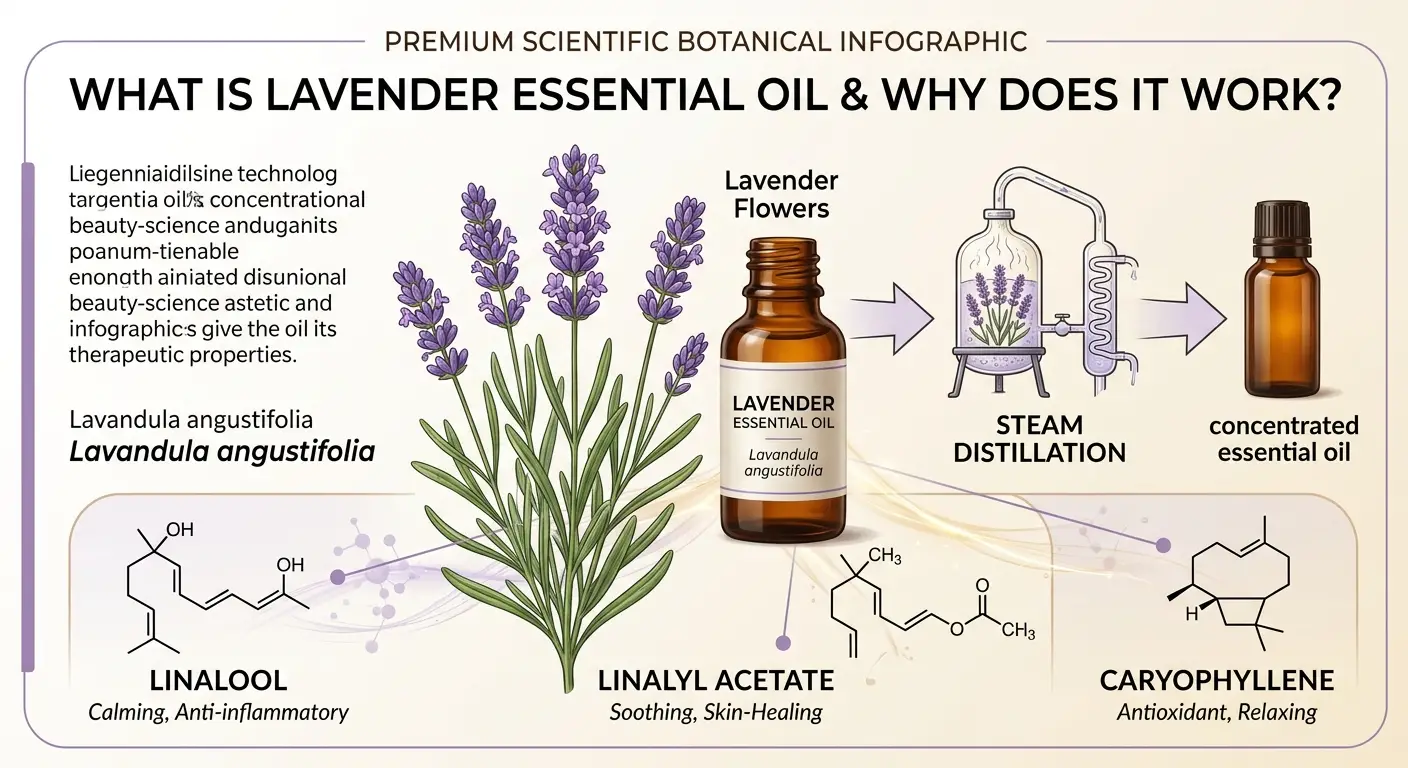
Key Compounds in Lavender Oil
- Linalool: An aromatic terpene alcohol found in lavender and other plants. It has been investigated for biological activity, but its presence does not establish that lavender oil treats a particular skin condition.
- Linalyl acetate: An aromatic ester that contributes to lavender’s characteristic scent. Like linalool, it can form oxidation products that may increase the risk of contact sensitization.
- Beta-caryophyllene: A sesquiterpene found in some lavender oils. Its concentration varies, and findings about isolated compounds should not be interpreted as proof of a specific cosmetic benefit from the complete oil.
The chemical composition helps explain why researchers continue to investigate lavender oil. It also explains why product quality, storage, and individual skin tolerance matter.
For a broader overview of the research, see this review of lavender essential oil composition and biological properties.
Understanding the chemistry behind this plant explains why the lavender essential oil beauty benefits are so effective for both skin healing and scalp health.
Potential Lavender Essential Oil Beauty Benefits
The most realistic lavender essential oil beauty benefits relate to its fragrance and its potential role as an ingredient in carefully formulated cosmetic products. Evidence is not equally strong for every proposed use.
| Beauty area | What the evidence suggests | Practical takeaway |
|---|---|---|
| Fragrance and body care | Lavender is widely used as a fragrance ingredient in cosmetics. | Choose a well-formulated product that suits your skin. |
| Blemish-prone skin | Laboratory research has examined antimicrobial activity, but evidence does not establish lavender oil as a reliable acne treatment. | Do not replace established acne care with essential oil. |
| Scalp care | Lavender has been studied in experimental formulations, but evidence for specific scalp benefits in humans remains limited. | Choose a suitable scalp product and monitor for irritation. |
| Hair growth | One frequently cited study reported changes in hair growth in mice. | Do not treat lavender oil as a proven human hair-loss treatment. |
| Cuticle and body care | Lavender can add fragrance to cosmetic oils and creams. | Use a properly formulated product rather than applying concentrated oil directly. |
A 2025 systematic review examined research on essential oils in skincare and noted the need for stronger, longer-term clinical evidence. Read the review of essential oils in skincare applications for further context.

How to Use Lavender Essential Oil More Safely
Lavender essential oil is a concentrated fragrance ingredient. Even when diluted, it may cause irritation or allergic contact dermatitis in susceptible individuals. A botanical origin does not guarantee that a product will be suitable for sensitive skin.
For everyday skincare, the simplest option is often a finished cosmetic product formulated and tested for its intended use.
Understanding Dilution
There is no single dilution percentage that is appropriate for every person, product, and application. The appropriate concentration depends on the finished formula, the area of application, frequency of use, product specifications, and individual tolerance.
For that reason, avoid relying on a universal drops-per-millilitre chart as a guarantee of safety. Drop sizes vary, and essential oils may not distribute evenly in every homemade mixture.
If you are developing a cosmetic formula, use a suitable formulation method and check the supplier’s recommended usage rate and relevant safety information. For facial use, reactive skin, or frequent long-term application, a professionally formulated fragrance-free product may be the better choice.
Patch Testing and Skin Tolerance
A patch test may help identify an immediate problem with a product, but it cannot guarantee that allergic contact dermatitis will not develop after repeated exposure.
-
Test only a properly formulated product, following its instructions.
-
Do not test undiluted essential oil directly on your skin.
-
Stop using the product if you experience redness, itching, burning, swelling, or a rash.
-
If you have a history of fragrance allergy or recurring dermatitis, seek advice from a dermatologist before trying fragranced products.
Research has shown that lavender oil can form sensitizing oxidation products after exposure to air. Read the published study on lavender oil oxidation and contact allergy.
4 Simple Lavender-Inspired DIY Beauty Ideas
DIY beauty routines can be enjoyable, but homemade products should not be assumed to be safe simply because they contain familiar ingredients. Essential oils need appropriate formulation, and water-containing mixtures may require a suitable preservative system.
The ideas below focus on simple cosmetic routines without asking you to add concentrated lavender oil directly to bathwater or untested homemade mixtures.
1. Simple Lavender-Free Bath Salts
A basic bath-salt blend is an easy way to create a relaxing bathing ritual without adding concentrated essential oil directly to the water.
Ingredients:
-
1 cup Epsom salt
-
1/2 cup sea salt
Instructions:
-
Combine the salts in a clean, dry bowl.
-
Stir until evenly mixed.
-
Transfer the blend to a dry, airtight container.
-
Add the salts to a warm bath according to your preference and the product instructions.
If you want a lavender fragrance, use a commercially formulated bath product intended for direct use in bathwater. Essential oil does not dissolve in water simply because it has been mixed with salt.
2. Gentle Sugar and Honey Body Scrub
A sugar scrub can help exfoliate rough areas such as elbows and knees. Sugar provides the physical exfoliation; it should not be described as a source of glycolic acid equivalent to a formulated chemical exfoliant.
Ingredients:
-
1/3 cup superfine sugar
-
1 tablespoon honey
-
1–2 tablespoons of a suitable cosmetic carrier oil, added gradually
Instructions:
-
Mix the honey and carrier oil in a clean bowl.
-
Stir in the sugar until the mixture reaches a texture you can spread comfortably.
-
Apply gently to damp, intact skin, avoiding the face, eye area, and irritated or freshly shaved skin.
-
Rinse thoroughly and pat dry.
Prepare a small amount for immediate use rather than storing a water-contaminated homemade scrub for an extended period. Do not add lavender essential oil unless the finished formula has been appropriately assessed for its intended use.
For more exfoliation ideas, explore our guide to 25 homemade body scrub recipes. You can also read our article on surprising beauty uses for coffee grounds for another DIY ingredient overview.
3. A Simple Bath-Milk Ritual
Powdered bath blends can be part of a self-care routine, but milk powders and other household ingredients may not suit every skin type. Avoid adding concentrated essential oil directly to a dry mixture unless you are using a properly developed formula.
For a simple alternative, choose a ready-made bath product intended for your skin type and follow its label directions. If your skin is sensitive, fragrance-free products are generally a more cautious starting point.
Avoid using baking soda as a treatment for balancing the skin’s pH. Its alkalinity may be unsuitable for some skin types, particularly when the skin barrier is already irritated.
4. Lavender-Scented Body Wash
A commercially formulated body wash is a more predictable option than mixing a new cleanser from household ingredients.
How to choose one:
-
Look for a body wash from a reputable manufacturer.
-
Check the ingredient list for lavender oil or fragrance if you want a scented product.
-
If your skin is reactive, consider a fragrance-free cleanser instead.
-
Follow the product’s directions and discontinue use if irritation develops.
Avoid adding essential oils, coconut milk, or extra carrier oils to a finished cleanser unless its manufacturer specifically supports that modification. Such changes can affect the formula’s stability, performance, and preservation. For a simple moisturizing routine, explore our DIY lavender foot balm recipe with five homemade balm variations.
How to Use Lavender Oil on Your Face
Facial skin can be particularly reactive to concentrated fragrance ingredients. Although lavender is common in cosmetic products, it should not be described as universally soothing or suitable for sensitive skin.
Choosing a Facial Oil for Your Skin Type
-
Oily or combination skin: A lightweight, non-comedogenic facial product may feel more comfortable than a rich oil.
-
Dry skin: A suitable moisturizer or facial oil may help reduce moisture loss and improve skin comfort.
-
Sensitive or reactive skin: A fragrance-free moisturizer is often a more cautious choice than a product containing essential oils.
Should You Make a Lavender Facial Oil?
For facial care, I recommend choosing a finished cosmetic product rather than providing a universal homemade lavender-oil recipe. Simply mixing essential oil into a carrier oil does not establish that the final product is suitable for facial use or for repeated application.
If your skin is already irritated, peeling, or over-exfoliated, introduce as few new products as possible. A fragrance-free routine is often the more sensible starting point.
Our skin barrier repair guide explains how to simplify skincare when the skin feels dry, tight, or irritated.
Lavender Essential Oil for Hair Growth: What Research Actually Shows
Lavender essential oil has attracted interest as a possible scalp-care ingredient, but evidence that it promotes hair growth in humans remains insufficient.
A frequently cited study, published in 2016, investigated topical lavender oil in female C57BL/6 mice. Researchers applied 3% or 5% lavender oil to shaved areas of the animals’ backs over four weeks and observed changes in hair follicles and hair growth compared with the untreated control group.
These findings are interesting, but they do not establish that lavender essential oil grows hair in humans. The study used an animal model, a specific formulation, and a controlled experimental setting.
Read the original study, Hair Growth-Promoting Effects of Lavender Oil in C57BL/6 Mice.
Choosing a Lavender Scalp-Care Product
If you enjoy the fragrance of lavender, look for a commercially formulated scalp product designed for your intended use. Follow the manufacturer’s directions and stop using it if your scalp becomes itchy, red, or irritated.
Do not assume that a product containing lavender will treat thinning hair, stimulate human hair growth, or address an underlying scalp condition. Sudden, persistent, or unexplained hair loss deserves assessment by a qualified healthcare professional.
How to Choose Lavender Essential Oil
When choosing lavender essential oil for cosmetic use, look beyond marketing terms such as “pure” and “natural.”
| Label indicator | What to look for |
|---|---|
| Botanical name | Lavandula angustifolia, if this is the species you want |
| Extraction method | Clearly stated steam distillation or another identified method |
| Ingredients | A clearly identified essential oil rather than an unspecified fragrance blend |
| Packaging | A tightly closing, light-protective container |
| Supplier information | Batch details, sourcing information, and appropriate storage guidance |
| Chemical analysis | GC/MS information where available, interpreted alongside other quality details |
GC/MS analysis can help describe an oil’s chemical profile, but it is not by itself a complete guarantee of purity, safety, or suitability for every cosmetic application.
Lavender Essential Oil Safety, Sensitization, and Storage
Lavender essential oil can cause skin irritation or allergic contact dermatitis in some people. Its fragrance compounds can also oxidize after exposure to air, and oxidation may increase their sensitizing potential.
The National Center for Complementary and Integrative Health notes that topical lavender products may cause allergic skin reactions in some individuals. You can read its lavender safety overview.
Safer Use
-
Do not apply undiluted lavender essential oil directly to the face or other sensitive areas.
-
Avoid contact with the eyes and mucous membranes.
-
Do not assume that a homemade mixture is safe because it contains natural ingredients.
-
Stop using a product if irritation, burning, swelling, or a rash develops.
-
Consider fragrance-free skincare if you have sensitive skin, a history of fragrance allergy, or an irritated skin barrier.
-
Do not use lavender oil as a substitute for appropriate treatment of acne, eczema, infections, or hair loss.
Storage
-
Keep the bottle tightly closed when not in use.
-
Store it away from direct sunlight and excessive heat.
-
Minimize unnecessary exposure to air.
-
Follow the supplier’s storage and shelf-life recommendations.
-
Do not continue using an oil if its quality is uncertain or it has been stored improperly.
Proper storage does not eliminate allergy risk, but following the manufacturer’s instructions helps maintain product quality.
Frequently Asked Questions
What are the main lavender essential oil beauty benefits?
Lavender essential oil is widely used as a fragrance ingredient in skincare, body-care, and scalp-care products. Researchers have also investigated its antimicrobial and anti-inflammatory properties, but evidence varies by application. It should not be presented as a proven treatment for acne, sensitive skin, or hair loss.
Can I apply lavender oil directly to my face?
Avoid applying undiluted lavender essential oil directly to facial skin. Concentrated essential oils may cause irritation or allergic contact dermatitis. If you prefer lavender-scented skincare, choose a finished cosmetic product formulated for facial use and discontinue it if your skin reacts.
Is lavender essential oil good for acne?
Lavender oil has been investigated for antimicrobial activity, but current evidence does not establish it as a reliable standalone acne treatment. For persistent or painful acne, consider evidence-based skincare or advice from a dermatologist rather than relying on essential oil alone.
Does lavender oil help with hair growth?
A 2016 study reported hair-growth effects in mice treated with lavender oil. Animal findings do not establish that the same effect occurs in humans, so lavender essential oil should not be described as a proven hair-growth or hair-loss treatment.
Can lavender oil unclog pores?
Lavender essential oil is not an established pore-cleansing treatment. If clogged pores are your concern, choose skincare products formulated for that purpose rather than relying on essential oil.
Is lavender oil suitable for dry cuticles?
A properly formulated cuticle product may help soften dry-feeling skin around the nails. Lavender can be included as a fragrance ingredient, but it is not a proven treatment for nail infections or other medical nail conditions. If fragrance causes irritation, choose a fragrance-free product.
Can lavender essential oil irritate sensitive skin?
Yes. Lavender oil and its fragrance compounds may trigger irritation or allergic contact dermatitis in susceptible people. Fragrance-free skincare may be a better option if you have reactive skin or a history of fragrance allergy.
Final Thoughts on Lavender Essential Oil Beauty Benefits
The most realistic lavender essential oil beauty benefits relate to its distinctive fragrance and its use in appropriately formulated cosmetic products. Research into topical and biological effects continues, but evidence should be interpreted according to the specific use and study design.
Lavender oil is not a proven acne treatment, a guaranteed solution for sensitive skin, or an established human hair-growth treatment. Animal studies and laboratory findings are useful starting points for research, not substitutes for clinical evidence.
For a more thoughtful DIY beauty routine, keep formulas simple, avoid applying concentrated essential oil directly to your skin, follow product instructions, and pay attention to signs of irritation. If your skin barrier is compromised or your skin is highly reactive, fragrance-free products may be the better choice.
Used with realistic expectations and attention to formulation safety, lavender can remain an appealing botanical fragrance in a well-considered beauty routine.

Lora Sokolov is a Lead Cosmetic Formulation Expert and skincare strategist at My Beauty Box Review, specializing in dermo-cosmetics, active ingredient analysis, and skin barrier recovery.

