
Choosing between Cicaplast Baume B5+ and Cicalfate+ can be confusing when your skin feels dry, irritated, over-exfoliated, or unusually sensitive. Both products are designed to support compromised skin and provide a protective, moisturizing layer, but their textures, ingredient profiles, and intended uses differ.
In this Cicaplast vs Cicalfate comparison, we’ll look at the key ingredients, texture, application experience, suitability for different skin concerns, and practical differences between the two formulas. We’ll also cover what to consider if your skin barrier has been affected by over-exfoliation, retinoids, or other irritating skincare products.
The Science of Skin Barrier Damage: Why Barrier Support Matters
The stratum corneum functions as your skin’s primary biological shield, operating under a delicate balance of ceramides, cholesterol, and free fatty acids. When this intercellular matrix breaks down due to environmental aggressors or harsh cosmetic treatments, Trans-Epidermal Water Loss (TEWL) spikes rapidly.
In any Cicaplast vs Cicalfate analysis, understanding how topical lipids reconstruct this extracellular matrix is essential. Severe barrier damage often manifests through specific clinical indicators:
-
Persistent Erythema: Chronic redness caused by dilated capillaries near the epidermal surface.
-
Trans-Epidermal Water Loss (TEWL): Accelerated moisture evaporation leading to deep cellular dehydration.
-
Stinging and Burning Sensations: Hyper-reactive nerve endings triggered even by basic water application.
-
Micro-Tears and Rough Texture: Disruptions in cell turnover caused by improper exfoliation techniques, such as over-using abrasive physical scrubs or unbuffered DIY treatments like homemade body scrub recipes.
La Roche-Posay Cicaplast Baume B5+ vs Avène Cicalfate+: Direct Formulation Breakdown
To accurately evaluate La Roche-Posay Cicaplast Baume B5 vs Avène Cicalfate, we must analyze their active biochemical components under a cosmetic chemistry lens. In this Cicaplast vs Cicalfate comparison, each formula relies on completely different therapeutic agents.
| Formulation Metric | La Roche-Posay Cicaplast Baume B5+ | Avène Cicalfate+ Restorative Cream |
| Primary Active Ingredient | 5% Panthenol (Pro-Vitamin B5) | [C+] Restore™ (Postbiotic biotechnology) |
| Soothing & Anti-Inflammatory | Madecassoside (Centella Asiatica) | Avène Thermal Spring Water |
| Antibacterial Shield | Zinc Gluconate & Manganese | Copper-Zinc Sulfate Complex |
| Microbiome Support | Tribioma (Prebiotic Complex) | Postbiotic Metabolites |
| Occlusive Base | Shea Butter & Glycerin | Mineral Oil & Zinc Oxide |
| Best For | Dehydration, Retinoid Peeling, Dryness | Active Inflammation, Oozing, Post-Acne |
Deep Dive into Ingredients: Cicaplast vs Cicalfate Key Actives
1. The Soothing & Healing Complexes: Cicaplast vs Cicalfate
La Roche-Posay utilizes a 5% concentration of Panthenol (Pro-Vitamin B5), a powerful humectant and biological precursor that accelerates fibroblast proliferation and deep tissue hydration. This is paired with purified Madecassoside, an isolated triterpenoid from Centella Asiatica that downregulates pro-inflammatory cytokines.
Conversely, in the Cicaplast vs Cicalfate showdown, Avène utilizes [C+] Restore™, a patented postbiotic nutrient derived from Aquaphilus dolomiae microbiota found exclusively in Avène Thermal Spring Water. According to independent dermatological studies indexed by the National Center for Biotechnology Information (NCBI), postbiotic lysates actively increase the rate of keratinocyte migration during epithelial wound healing.
2. Microbial Protection & Barrier Integrity in Cicaplast vs Cicalfate
Preventing opportunistic bacterial colonization on compromised tissue is vital:
-
Avène Cicalfate+ relies on a classic Copper-Zinc Sulfate Complex, creating a hostile environment for harmful pathogens while promoting rapid tissue regeneration.
-
Cicaplast Baume B5+ incorporates Tribioma, a prebiotic complex designed to rebalance the skin’s beneficial microflora, preventing Staphylococcus overgrowth without drying the skin.
Personal Experience: A 14-Day Cicaplast vs Cicalfate Comparison
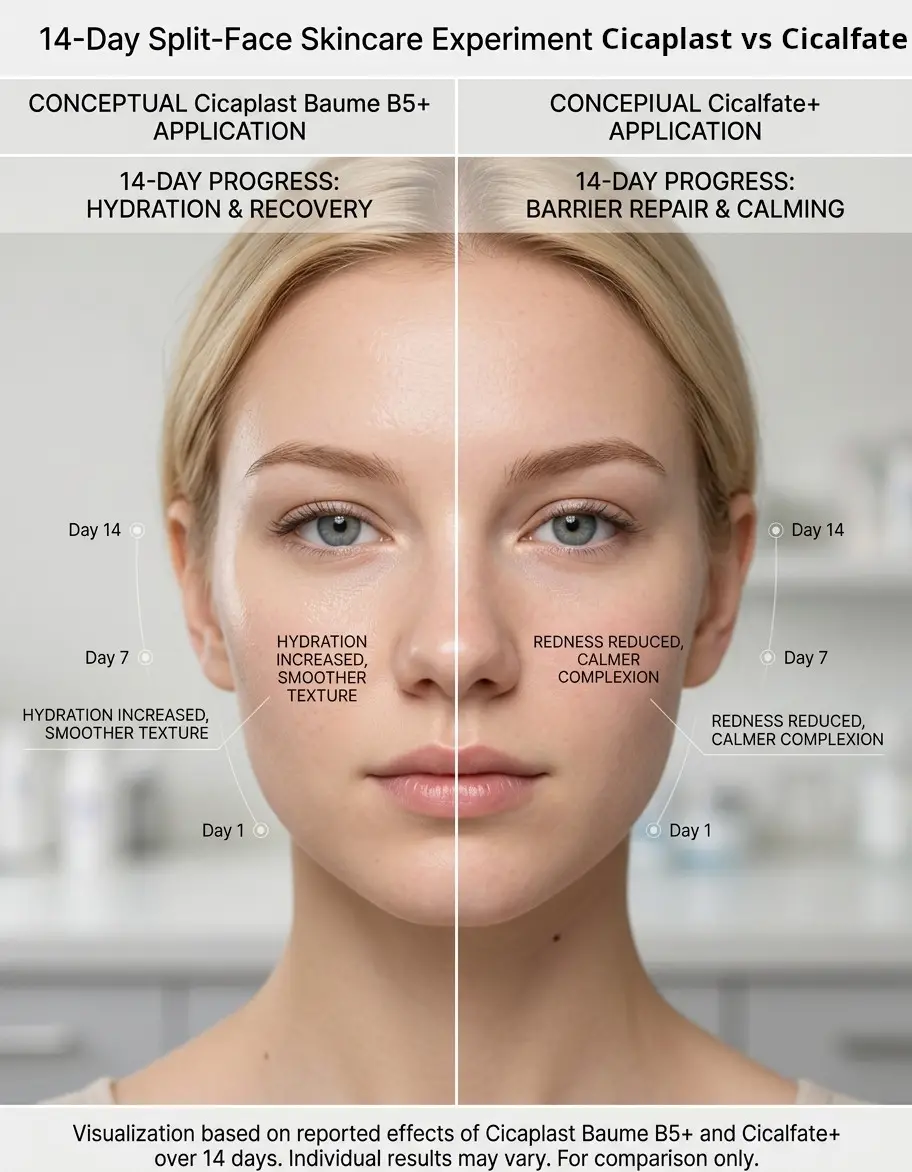
I compared the two products over a 14-day period as a personal skincare experiment. This was an individual experience, not a clinical study, and the observations below should not be interpreted as medical or laboratory measurements.
Days 1–3: Acute Inflammation Phase
-
Left Side (Cicaplast B5+): Stinging subsides within 60 seconds of application. The 5% Panthenol provides instant soothing, but severe dry patches require reapplication every 4 to 5 hours.
-
Right Side (Cicalfate+): The dense zinc oxide paste feels cool upon contact. It forms an impenetrable barrier that completely blocks external air sensitivity, though it requires gentle warming between fingertips to spread over tender skin.
Days 4–7: Epidermal Regeneration Phase
-
Left Side (Cicaplast B5+): Flaking decreases significantly. The skin feels noticeably plumper and hydrated due to the glycerin and shea butter base.
-
Right Side (Cicalfate+): Redness resolves roughly 24 hours faster than on the Cicaplast side. The antibacterial copper-zinc complex prevents any localized breakout activity in raw areas.
Days 8–14: Barrier Consolidation
-
Left Side (Cicaplast B5+): Texture completely restored. The area appeared less dry to me with zero residual peeling.
-
Right Side (Cicalfate+): Erythema entirely clear. The skin feels protected, though the heavy mineral base feels slightly rich once the acute inflammation has fully healed.
Takeaway: In this Cicaplast vs Cicalfate trial, Cicaplast excels at continuous moisture retention and comfort, while Cicalfate acts faster at neutralizing intense redness and acute raw irritation.
Cicalfate vs Cicaplast for Acne Skin Barrier: Will They Clog Pores?
A primary concern when choosing the best repair cream for damaged skin barrier recovery is the risk of pore congestion, particularly for acne-prone skin types. When dealing with a cicalfate vs cicaplast for acne skin barrier dilemma, analyzing the comedogenic potential of their lipid bases is essential.

1. Avène Cicalfate+ on Acne-Prone Skin
Cicalfate+ has a rich, protective texture that some people with acne-prone skin may find heavy when applied over large areas. Others may prefer the occlusive feel when dealing with localized dryness or irritation.
The important point is that a product’s suitability depends on the complete formulation and your individual skin response. If you are prone to clogged pores, start with a small amount and observe how your skin reacts rather than assuming that either product will be universally non-comedogenic.
2. La Roche-Posay Cicaplast Baume B5+ on Acne-Prone Skin
Cicaplast Baume B5+ also has a nourishing, protective texture and may feel rich on very oily skin. A thin layer can be more comfortable than applying a large amount, particularly during the daytime.
Neither product should be treated as an acne medication. If acne or persistent breakouts are your main concern, choose products based on your broader skincare routine and seek professional advice when needed.
Texture, Spreadability, and Aesthetic Finish: Cicaplast vs Cicalfate
Evaluating texture is critical when performing a comprehensive skin barrier repair cream comparison.
Application Experience: Cicaplast Baume B5+
La Roche-Posay designed Cicaplast Baume B5+ to function smoothly under daily skincare regimens. It spreads fluidly across inflamed skin without requiring aggressive tugging or friction.
-
Finish: Dewy, hydrated, and soft.
-
White Cast: Minimal to none once fully massaged into the skin.
-
Wearability: Functions exceptionally well over hydrating serums and can be worn under broad-spectrum sunscreen.
Application Experience: Avène Cicalfate+
Avène Cicalfate+ presents a traditional pharmaceutical paste consistency. Due to the high concentration of zinc oxide and protective waxes, it requires gentle warming between fingertips before application.
-
Finish: Heavy, protective, semi-matte occlusive layer.
-
White Cast: Noticeable temporary pale cast due to micronized zinc oxide.
-
Wearability: Best reserved for nighttime recovery regimens, spot treatments, or as a protective barrier shield during harsh winter weather.
How to Support a Damaged Skin Barrier: Step-by-Step Routine
Restoring a compromised epidermal barrier requires a streamlined, non-irritating routine. Avoid harsh alkaline home remedies like applying baking soda for skin care, as high pH substances strip essential stratum corneum lipids and destroy the natural acid mantle.
If you’re looking for a broader step-by-step explanation of barrier damage, recovery, and what to avoid while your skin is irritated, see our skin barrier repair guide.
Follow this clinical protocol to restore skin integrity using your chosen repair balm:
Step 1: Gentle Non-Stripping Cleansing
Cease using all physical exfoliants, cleansing brushes, and active chemical acids (AHAs, BHAs, PHAs). Wash with lukewarm water and a pH-balanced (5.5), sulfate-free non-foaming cleanser.
Step 2: Hydrating Base Layer
Apply a simple humectant serum containing pure Hyaluronic Acid or Glycerin to damp skin to trap water in the upper layers of the epidermis.
Step 3: Apply Your Chosen Barrier Cream
Apply a thin, even layer of your chosen product according to the manufacturer’s directions.
- Cicaplast Baume B5+ may be a practical choice when you prefer a lighter balm texture for dryness, irritation, or areas affected by over-exfoliation.
- Cicalfate+ may appeal to those who prefer a thicker, more protective cream texture for dry or irritated areas.
Avoid applying either product to open wounds or areas that require medical treatment unless a healthcare professional has advised you to do so.
Step 4: Strict Photoprotection
UV radiation degrades regenerating epidermal tissue. Finish your daytime routine with a high-protection mineral sunscreen containing non-nano Zinc Oxide or Titanium Dioxide.
Specific Clinical Use Cases: Which Cream to Use and When
To maximize skin recovery, select your protective balm based on the precise cause of your epidermal damage.
1. Retinoid-Induced Dermatitis (Tretinoin, Retinol, Adapalene)
When initiating prescription retinoids or high-strength retinaldehydes, accelerated cell turnover frequently causes erythema, localized desquamation (peeling), and compromised lipid barriers.
-
The Winner: La Roche-Posay Cicaplast Baume B5+
-
Why: The combination of 5% Panthenol and Madecassoside speeds up tissue tolerance without suffocating the skin. Applying a thin layer of Cicaplast over your retinoid (the “Sandwich Method”) buffers irritation while maintaining retinoid efficacy.
2. After Professional Skin Treatments
After procedures such as chemical peels, laser treatments, or microneedling, skincare should follow the specific aftercare instructions provided by your dermatologist or treatment provider.
If a barrier cream is recommended as part of your aftercare routine, Cicaplast Baume B5+ and Cicalfate+ are two products worth comparing based on their texture, ingredients, and how your skin tolerates them.
3. Very Sensitive or Reactive Skin
If your skin is affected by a diagnosed condition such as eczema or perioral dermatitis, product selection should be guided by your dermatologist rather than by a general product comparison.
For uncomplicated dryness or irritation, you can compare Cicaplast and Cicalfate based on their ingredient lists, texture, and how your own skin responds.
Budget-Friendly Alternatives: 3 Dupes Under $15
If you are looking for a skin barrier repair cream comparison that covers affordable drugstore alternatives, these three formulations offer comparable barrier recovery active ingredients without the French pharmacy price tag.
1. Purito Seoul B5 Panthenol Re-Barrier Cream
-
Key Actives: 10% Panthenol, Centella Asiatica Extract, Squalane, Niacinamide.
-
Why It Works as a Dupe: It doubles the Panthenol concentration of Cicaplast Baume B5+ (10% vs 5%) in a lighter, gel-cream texture that is ideal for combination and oily skin types.
2. Eucerin Aquaphor Healing Ointment
-
Key Actives: 41% Petrolatum, Panthenol, Bisabolol, Glycerin.
-
Why It Works as a Dupe: The ultimate heavy occlusive alternative to Avène Cicalfate+. While it lacks zinc oxide, its petrolatum base prevents up to 98% of Trans-Epidermal Water Loss (TEWL) for acute localized dry patches.
3. Pyunkang Yul ATO Cream Blue Label
-
Key Actives: Ceramide NP, Macadamia Nut Oil, Lonicera Japonica (Honeysuckle) Flower Extract.
-
Why It Works as a Dupe: Formulated specifically for ultra-sensitive skin, this minimalist Korean cream mimics the lipid structure of the stratum corneum, offering deep nourishment at a fraction of the cost per ounce.
Frequently Asked Questions (FAQ)
Can I use Cicaplast or Cicalfate as a daily moisturizer?
While both balms are safe for daily use, they are designed as therapeutic recovery treatments rather than standard cosmetic moisturizers. For normal or combination skin types, daily use across the entire face may feel overly occlusive. Use them daily during active barrier repair cycles (typically 2 to 4 weeks), then transition back to a lighter daily moisturizer once your skin barrier function normalizes.
Can you leave Cicaplast or Cicalfate on overnight?
Yes. Both products can be left on overnight if your skin tolerates them. Apply them according to the product directions and use a thinner layer if a generous application feels too heavy.
Which is better for repairing a skin barrier damaged by acids?
For barriers damaged by chemical over-exfoliation (such as Glycolic, Salicylic, or Lactic acids), La Roche-Posay Cicaplast Baume B5+ is typically preferred. Its humectant-rich formulation rehydrates parched stratum corneum layers while Madecassoside calms active chemical burning.
Are these creams safe for fungal acne (Malassezia folliculitis)?
Neither cream is 100% fungal-acne safe. Cicaplast contains Shea Butter and fatty acid esters, while Cicalfate contains specific lipid compounds that can potentially feed Malassezia yeast under prolonged occlusive conditions. If you have active fungal acne, use minimal amounts strictly as localized spot treatments.
Final Verdict: Cicaplast vs Cicalfate – Which Should You Choose?
When comparing Cicaplast vs Cicalfate, there is no universal winner. The better choice depends on the texture you prefer, the type of dryness or irritation you’re dealing with, and how your skin responds to each formula.
- Choose La Roche-Posay Cicaplast Baume B5+ if you prefer a versatile barrier balm with a relatively smooth texture for dryness, irritation, or over-exfoliation.
- Choose Avène Cicalfate+ if you prefer a thicker, more protective cream texture for dry or irritated areas.
If your skin is persistently painful, severely inflamed, infected, or not improving with a gentle skincare routine, consider speaking with a dermatologist rather than relying on a cosmetic barrier cream alone.
The My Beauty Box Review editorial team writes about DIY skincare, beauty subscription boxes and clean beauty. We link our sources and include safety notes. We are not dermatologists or cosmetic chemists.
