
DIY lavender foot balm is a simple way to add moisturizing care to your nighttime routine. Whether your heels feel dry after a long day or you simply enjoy a relaxing self-care ritual, a homemade foot balm can help soften the feel of dry skin without requiring a long list of ingredients.
This guide includes 5 easy homemade foot balm recipes, from a simple coconut oil balm to richer blends made with shea butter, cocoa butter, and beeswax. You will also learn how to prepare, store, and use each variation, plus important safety tips for lavender essential oil and other botanical ingredients.
Although this recipe collection is inspired by the idea of Sweet Dreams Cream, these preparations are oil-based balms, not traditional water-based creams. They are intended for cosmetic moisturization and do not treat insomnia or other medical conditions.
What Is a DIY Lavender Foot Balm?
A DIY lavender foot balm is an oil-based skin-care preparation designed to soften dry areas of the feet. Depending on the ingredients, a balm can range from a soft oil blend to a firm, wax-based product.
Coconut oil, shea butter, cocoa butter, and sunflower oil are commonly used in homemade body-care preparations because they help condition the skin and improve its feel. Beeswax can make an oil blend firmer and create a more substantial protective layer.
Lavender essential oil is optional. It provides fragrance, but it is not necessary for moisturizing dry feet and may cause irritation or allergic reactions in some people.
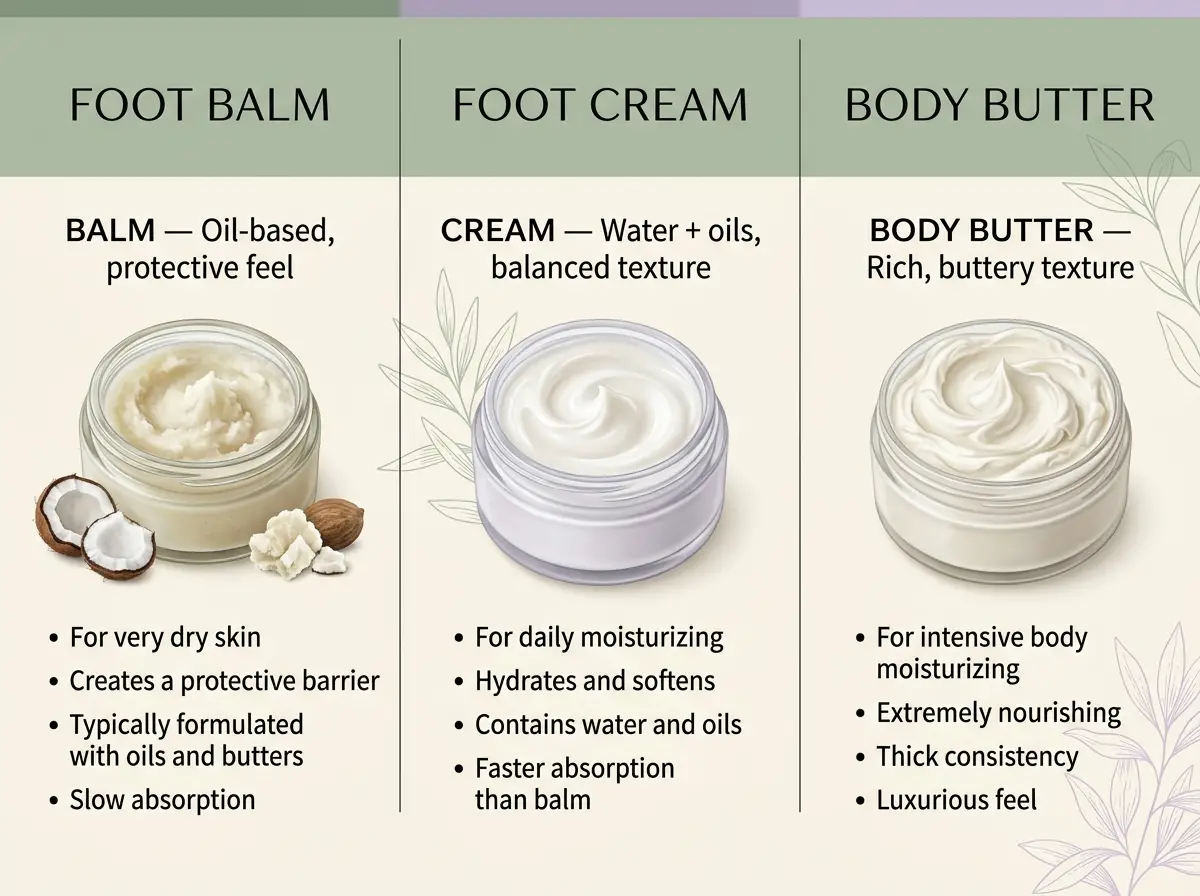
Balm vs. Cream vs. Body Butter
| Product | Typical Composition | Main Characteristics |
|---|---|---|
| Foot balm | Primarily oils, butters, and sometimes wax | Rich, often protective, and usually water-free |
| Foot cream | Water, oils, emulsifiers, and other ingredients | Often lighter and formulated with both water- and oil-based components |
| Body butter | Primarily plant butters and oils | Rich texture that softens as it warms against the skin |
A water-free balm is relatively simple to make, but that does not mean it is automatically contamination-proof or suitable for everyone. Clean equipment, dry storage, appropriate ingredients, and realistic shelf-life expectations still matter.
Ingredients for Homemade Foot Balm
You can make a basic balm with one ingredient or combine several ingredients to change its texture.
| Ingredient | Why It Is Used | What to Consider |
|---|---|---|
| Coconut oil | Helps soften dry skin | Can feel greasy and becomes liquid in warm conditions |
| Shea butter | Adds richness and body | Produces a thicker, creamier texture |
| Cocoa butter | Helps create a firm balm | Has a naturally solid texture and characteristic scent |
| Sunflower oil | Provides a lighter liquid-oil component | Makes blends softer and easier to spread |
| Olive oil | Adds a rich, oily feel | Can make the finished blend softer or greasier |
| Beeswax | Firms an oil-based preparation | Too much can make the balm stiff and difficult to spread |
| Lavender essential oil | Adds fragrance | Optional; may irritate sensitive skin |
Choose ingredients intended for cosmetic or topical use and follow their suppliers’ storage and handling instructions.
5 Easy DIY Foot Balm Recipes

These five recipes use small batches and straightforward methods. The quantities are starting formulations for texture and cosmetic use, not clinically tested products. They have not undergone stability or microbiological testing, so a guaranteed shelf life cannot be assigned.
Before you begin: Wash your hands, clean your utensils and containers thoroughly, and allow them to dry completely. Keep water away from the ingredients and finished products.
Recipe 1: Simple Coconut Oil Foot Balm
Best for: Anyone who wants a one-ingredient, fragrance-free option.
Ingredients
- 30 g coconut oil
Instructions
- Check that your coconut oil is clean and suitable for topical use.
- If it is too firm to scoop, soften it gently using a warm-water bath.
- Transfer the oil into a clean, completely dry container.
- Allow it to return to its usual consistency before closing the lid.
- Apply a small amount to dry, intact skin on the heels and soles.
Why choose this recipe?
This is the simplest version because it requires no added fragrance, wax, or additional butter. Coconut oil acts as an emollient, helping the skin feel softer.
The texture changes with temperature. In a cool room, the balm may be firm; in a warm room, it may become liquid. This is a normal characteristic of coconut oil.
Tip: Start with a small amount. A thick layer can leave the feet slippery, especially when walking on smooth floors.
Recipe 2: Coconut Oil and Shea Butter Balm
Best for: People who prefer a richer, more substantial texture.
Ingredients
- 20 g coconut oil
- 10 g shea butter
Instructions
- Place the coconut oil and shea butter in a clean, heat-safe bowl.
- Warm them gently until softened or melted, stirring as needed.
- Remove the bowl from the heat.
- Transfer the mixture into a clean, completely dry container.
- Let the blend cool and set before using a small amount on dry heels and soles.
Why choose this recipe?
Shea butter adds richness and changes the consistency of the coconut oil. The result may feel thicker than the one-ingredient version, although its firmness will still depend on room temperature.
This recipe does not require essential oils. Leaving out fragrance is a useful option if you have sensitive skin or simply prefer an uncomplicated moisturizer.
Tip: Avoid overheating the ingredients. Gentle warming is sufficient to combine them.
Recipe 3: Shea Butter and Sunflower Oil Balm
Best for: Those who want a soft balm that spreads more easily.
Ingredients
- 20 g shea butter
- 10 g sunflower oil intended for topical use
Instructions
- Place the shea butter in a clean, heat-safe bowl.
- Warm it gently until it softens.
- Stir in the sunflower oil until the mixture looks uniform.
- Transfer it to a clean, dry container.
- Allow it to cool before testing a small amount on intact skin.
Why choose this recipe?
Sunflower oil makes the blend softer and easier to spread than a preparation containing only solid butters. Shea butter adds richness, while the liquid oil changes the final texture.
The mixture may become softer in a warm room and firmer in a cool one. If you prefer a firmer product, adjust the balance in a future small batch rather than adding ingredients at random.
Tip: If your skin reacts to a particular oil or butter, discontinue use. Plant-derived ingredients can still cause irritation or allergy.
Recipe 4: Beeswax and Sunflower Oil Foot Balm
Best for: Those who prefer a firmer balm that is less likely to run when the room is warm.
Ingredients
- 20 g sunflower oil intended for topical use
- 5 g beeswax
Instructions
- Place the beeswax and sunflower oil in a heat-safe bowl.
- Warm the mixture gently using a water bath until the beeswax melts.
- Stir carefully until the ingredients are combined.
- Pour the mixture into a clean, completely dry, heat-safe container.
- Allow it to cool fully before handling or applying.
Take care when working with heated wax and containers. Avoid overheating the mixture, and keep hot equipment away from children.
Why choose this recipe?
Beeswax gives the balm a firmer structure and helps create a more substantial layer on the skin. This makes it different from softer coconut-oil blends.
The finished texture depends on the ingredients and their proportions. This small-batch recipe is a starting point rather than a professionally validated cosmetic formula.
Tip: Test the cooled texture before applying generously. A balm that is too firm may be difficult to spread, while a softer mixture may feel oilier.
Recipe 5: Cocoa Butter and Coconut Oil Balm
Best for: People who enjoy a firm, rich balm with a simple ingredient list.
Ingredients
- 20 g cocoa butter
- 10 g coconut oil
Instructions
- Place the cocoa butter and coconut oil in a clean, heat-safe bowl.
- Warm gently until the cocoa butter melts and the oils combine.
- Stir the mixture carefully.
- Transfer it into a clean, completely dry container.
- Allow it to cool and solidify before using a small amount on dry skin.
Why choose this recipe?
Cocoa butter gives the blend a firmer texture, while coconut oil makes it easier to spread once warmed by the skin. The result is a rich, oil-based balm without added fragrance.
Cocoa butter has its own characteristic scent, so this recipe will not necessarily smell neutral. If you prefer to avoid fragrance and distinctive natural aromas, the simple coconut oil recipe may be a better choice.
Tip: Apply sparingly and allow the product to absorb as much as it will before putting on socks.
How to Add Lavender to Your Foot-Care Routine
Lavender (Lavandula angustifolia) is widely used as a fragrance ingredient in personal-care products. Some people enjoy its aroma as part of an evening routine, but individual responses to scent vary.
Lavender essential oil is concentrated. It should not be applied undiluted, and there is no single drop count that can be assumed to be suitable for every essential oil product and every person.
If you want a lavender-scented version of one of the recipes above, use only a product specifically intended for topical cosmetic use and follow its manufacturer’s dilution and safety instructions. Do not estimate a concentration based on an arbitrary number of drops. If you cannot verify the appropriate instructions, leave the essential oil out.
Avoid adding lavender tea, water, hydrosols, or other water-based ingredients to these recipes. Introducing water changes the formulation and can increase preservation requirements.
For reliable background information, read the National Center for Complementary and Integrative Health’s overview of lavender. The evidence concerning lavender varies by use, and a scented foot balm should not be described as a proven sleep aid.
How to Use an Overnight Foot Moisturizer
A homemade foot balm can be incorporated into a simple evening foot-care routine.
- Clean your feet. Wash them gently when needed.
- Dry them thoroughly. Pay particular attention to the skin between the toes.
- Apply a small amount. Spread a thin layer over dry areas of the heels and soles.
- Avoid the spaces between the toes. Do not leave a heavy, oily layer where moisture may accumulate.
- Consider wearing clean socks. This may reduce transfer to bedding, but make sure you can walk safely and avoid slippery surfaces.
Coconut oil and other oily ingredients can make floors slippery. Apply your balm while seated and avoid walking barefoot immediately afterward.
Use the balm on intact skin. Deep cracks, bleeding, persistent irritation, or signs of infection require appropriate professional advice rather than relying on a homemade cosmetic preparation.
DIY Foot Balm vs. Commercial Foot Creams
Homemade balms are simple, but they are not necessarily the best option for every foot-care concern.
| Option | Potential Benefit | Consideration |
|---|---|---|
| Homemade oil-based balm | Simple ingredients and customizable texture | No validated shelf life or formal stability testing |
| Fragrance-free foot cream | Can combine water-binding and skin-softening ingredients | The result depends on the specific formulation |
| Foot cream containing urea | Some formulations are designed to soften rough, thickened skin | Concentration and suitability vary by product |
| Lavender-scented balm | Adds fragrance to a moisturizing routine | Fragrance may irritate sensitive skin |
Some commercial foot creams contain ingredients such as urea or lactic acid that are formulated for rough or thickened skin. These products serve different purposes from a simple oil-based balm, and the best option depends on the person’s skin and needs.
For general information about caring for dry or sensitive skin, see our skin barrier repair guide. A homemade balm may soften the skin’s surface, but it should not be described as repairing a damaged skin barrier.
Essential-Oil Safety and Skin Sensitivity
Natural ingredients are not automatically safe for every person. Essential oils are concentrated fragrance materials and can cause irritation or allergic contact dermatitis.
Keep these precautions in mind:
- Do not apply undiluted lavender essential oil directly to your skin.
- Follow the manufacturer’s topical-use instructions for any essential-oil product.
- Choose a fragrance-free recipe if you have known fragrance sensitivity.
- Avoid applying the balm to open wounds, bleeding cracks, or infected skin.
- Stop using the product if you develop itching, burning, redness, swelling, or a rash.
- Keep homemade preparations away from the eyes and mucous membranes.
- Store products away from children and pets.
A small-area trial may help you notice an immediate reaction, but it cannot guarantee that an allergic reaction will not occur later. If you have a history of reactions to essential oils, seek appropriate professional guidance before trying a fragranced preparation.
Storage and Shelf Life
Store each balm in a clean, dry, tightly closed container away from direct sunlight and heat. Use a clean, dry spatula or clean, dry hands to remove the product, and avoid introducing water into the container.
These recipes have not undergone stability or microbiological testing. Therefore, it would be misleading to promise a specific shelf life, such as six or twelve months. Make small batches, follow the storage instructions for your ingredients, and discard the product if you suspect contamination or notice an unexpected change in smell, appearance, or texture.
Frequently Asked Questions
1. What is the easiest DIY lavender foot balm recipe?
The easiest option is the one-ingredient coconut oil balm. It requires no melting if the oil is already soft enough to scoop. You can keep it fragrance-free or explore a properly formulated lavender-scented product separately.
2. Can I use coconut oil on my feet every night?
Frequency depends on your skin and how it responds. If a small amount helps soften dry skin without causing irritation, it may fit into your evening routine. Reduce use or stop if you notice an unwanted reaction. Avoid applying a heavy layer between the toes.
3. How much lavender essential oil should I add?
There is no universal number of drops that is appropriate for every essential oil and every homemade formula. Follow the specific product’s topical-use instructions and safety guidance. If you cannot verify the appropriate dilution, leave the essential oil out.
4. Will a homemade foot balm help cracked heels?
An oil-based balm may help soften mild dryness on intact skin. Deep, painful, bleeding, or persistent cracks may require professional assessment. People with diabetes, reduced sensation, or circulation problems should seek appropriate medical guidance about foot problems rather than relying solely on home remedies.
5. Can I add water, aloe vera, or herbal tea to these recipes?
Not without changing the formulation and addressing preservation. These recipes are designed as oil-based balms. Water-based ingredients can introduce additional microbial risks and generally require an appropriately formulated preservative system and suitable testing.
6. Does lavender foot balm help with sleep?
A scented evening routine may feel pleasant or relaxing to some people, but this homemade cosmetic product is not a proven treatment for insomnia or other sleep disorders. Use it for foot moisturization rather than as a sleep treatment.
7. How long does homemade foot balm last?
There is no validated shelf life for these specific homemade recipes. Storage conditions, ingredient quality, and contamination can affect product quality. Make small batches, keep water out, follow ingredient storage guidance, and discard any product that appears or smells unusual.
Final Thoughts
A DIY lavender foot balm can be a simple addition to a nighttime self-care routine, but you do not need essential oils or a complicated recipe to moisturize dry feet.
Choose from these five homemade foot balm recipes according to the texture you prefer: simple coconut oil, a richer shea butter blend, a softer sunflower oil balm, a firmer beeswax preparation, or a cocoa butter and coconut oil combination.
Keep the ingredients simple, use clean and completely dry equipment, store each preparation carefully, and pay attention to how your skin responds. If your main concern is persistent cracking, pain, or another skin problem, seek appropriate professional advice rather than relying on a homemade balm.

Lora Sokolov is a Lead Cosmetic Formulation Expert and skincare strategist at My Beauty Box Review, specializing in dermo-cosmetics, active ingredient analysis, and skin barrier recovery.

